

Poker is a combination of ability, psychology, math, and intuition; it’s not just a card game. Poker has emerged as one of the most recognisable games in the world, played on home tables, online, and in casinos. Learning to play poker can be intimidating if you’ve never done it before. Don’t worry, though; this thorough tutorial will teach you everything you need to know to start playing poker with assurance.
This tutorial is the first step towards comprehending the rules, methods, and etiquette that define the game of poker, regardless of whether you want to participate in online poker tournaments or join a friendly game.
1. First, what is poker?
Players compete to make the best hand possible—or persuade others that they have one—using a variety of ranking systems in the poker family of card games. Although there are several varieties, including Omaha, Seven-Card Stud, and Five-Card Draw, Texas Hold’em is currently the most played.
Poker is special because it blends strategy (you choose how to gamble depending on the knowledge you have) with chance (you have no control over which cards you receive). The combination of skill and luck is what makes poker so rewarding and addictive.
2. Poker’s Goal
In the majority of poker games, the main goal is to win chips or cash by forcing other players to fold before the showdown or by having the better hand at showdown. To create the strongest five-card hand possible, players combine shared cards, also known as community cards, with personal cards, also known as hole cards.
But playing poker well is more important than simply getting good cards. By reading their opponents and placing wise bets, players frequently win with inferior cards.
3. Comprehending Poker Hand Rankings
Understanding how hands are ranked from top to lowest is necessary before you can play poker effectively:
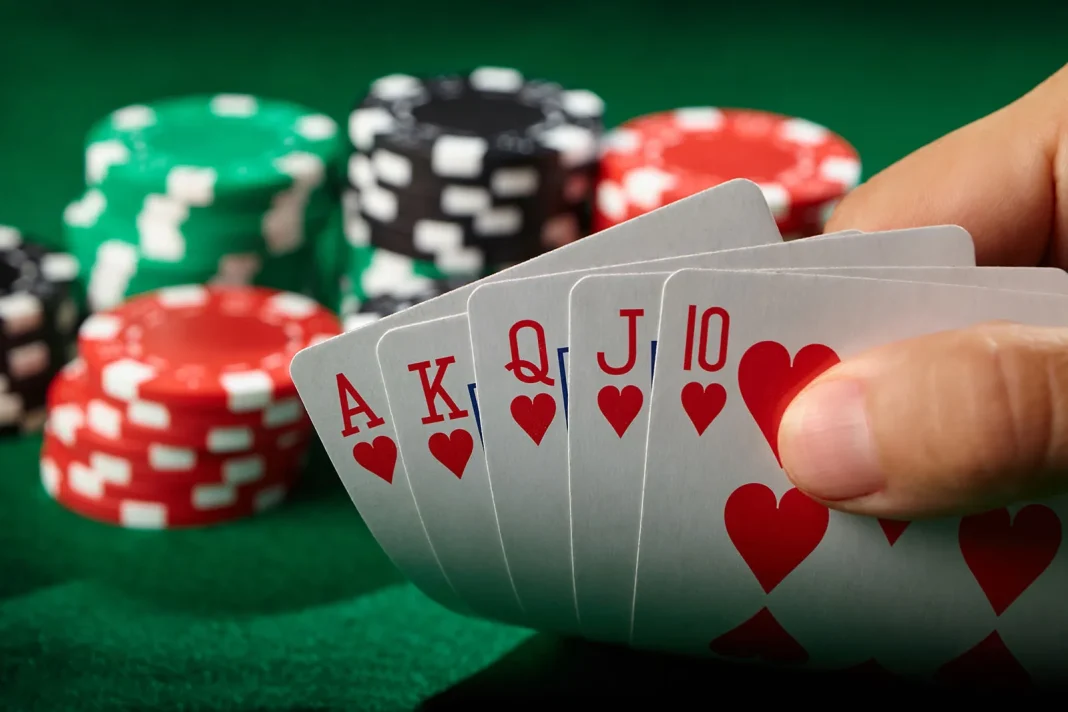
Royal Flush: the same suit’s A, K, Q, J, and 10.
Five cards of the same suit in a row is known as a straight flush.
Four cards of the same rank are referred to as four of a kind.
Three of a kind plus a pair make up the full house.
Flush: Five identical but non-sequential cards from the same suit
Straight: Any suit, five consecutive cards
Three cards of the same rank are referred to as three of a kind.
Two Pair: Two card pairs (two 8s and two 5s, for example).
One Pair: A single set of cards, such as two Kings.
High Card: The highest card wins if no other hand is formed.
Making the best betting choices requires an understanding of hand rankings.
4. Poker Variants: Texas Hold’em Is the Main Focus
Although the rules of different poker games can differ, we’ll concentrate on Texas Hold’em, the most popular variation, for the purposes of this guide.
In Texas Hold’em:
Two secret cards (hole cards) are dealt to each participant.
Five face-up community cards are dealt in the centre of the table.
To create the finest five-card hand, players can employ any combination of the seven cards (2 hole + 5 community).
5. Positions and the Poker Table
How you approach the game is greatly influenced by where you sit at the table. Two key ideas are as follows:
The dealer button is a revolving indicator that establishes the betting sequence.
Blinds: The small blind and the big blind are the two players to the left of the button post forced bets.
Since you can see what other players do before you do, you usually have a greater advantage the closer you are to the dealer button (acting later in the betting round).
6. Fundamental Poker Gameplay Framework
A typical Texas Hold’em hand goes through the following steps:
Pre-Flop: The player left of the large blind places the first wager after each player receives two hole cards.
Flop: The dealer deals three face-up community cards. A fresh betting round starts.
Turn: The dealer deals a fourth community card. One more round of betting.
River: The fifth and last card dealt is the communal card. last round of betting.
Showdown: The best five-card hand wins when the remaining players disclose their cards.
A player has the option to raise (increase the bet), call (match the existing wager), fold (give up), or check (pass action if no bet is made) at any time.
7. An explanation of poker betting actions
During a betting round in poker, a player can do four primary things:
Fold: Discard your hand to end the round.
Call: To maintain control, match the biggest wager currently in place.
Raise: In order to compel others to match or fold, raise the current wager.
Verify: You can watch the event without placing a wager if nobody has.
The secret to a winning poker strategy is knowing when to use each of these acts.
8. Recognising the Antes and Blinds
Forced bets are used in the majority of poker games to generate initial action:
Blinds: The two players to the left of the dealer must place both small and large blind bets. This makes each hand revolve.
Antes: Sometimes, all players donate a tiny amount before the hand begins.
By guaranteeing that there is always something to win in every pot, blinds and antes promote active play.
9. Essential Poker Techniques for Novices
Here are some beginner-friendly poker tips to help you start winning:
Play tight, not loose: Don’t pursue bad starting hands; instead, stick to strong ones.
Be aggressive: Rather than just calling when you have a solid hand, bet and raise.
Be mindful of your position: Play fewer hands from early position and more from late position (close to the dealer).
Don’t bluff too much: Bluffing is a valuable tactic, but it should only be employed in certain situations.
Keep an eye on your rivals: To determine a person’s strength or weakness, look at their betting habits.
10. Typical Poker Errors to Steer Clear of
Even seasoned gamers might develop negative behaviours. The following are some errors to avoid:
Too many hands being played
Calling rather than lifting with powerful hands
Not keeping your bankroll under control
Allowing feelings to influence your choices
Disregarding table dynamics and position
In poker, self-control is just as crucial as knowledge.
11. The Art of Poker Psychology: Reading Opponents
Reading your opponents is just as important in poker as knowing your cards. Seek out:
Do they consistently place bets or do they frequently bluff?
Time tells: Quick wagers may be a sign of bluffing or confidence.
In live games, body language can include shaky hands, nervous gestures, or averting eye contact.
What sets novices apart from experts is learning to “read” players.
12. Semi-Bluffing & Bluffing
Bluffing is the practice of placing a wager or raising a weak hand in an attempt to force opponents to fold stronger hands. Another option is semi-bluffing, in which you have a drawing hand that could get better with time.
Successful bluffing depends on:
Your image at the table (tight players are more credible)
Tendencies of the opposition
Board texture—did someone probably hit the flop?
Bluff strategically, not in a panic.
13. Management of Bankrolls
Even if you play well, you will experience losing streaks since poker is a variable game. Bankroll control is therefore essential. Don’t risk money you can’t afford to lose.
Establish boundaries for every session.
Don’t chase losses.
Increase the stakes gradually as you get better.
You can play the game for longer if you follow a strict bankroll plan.
14. Live versus Online Poker
Both live and internet poker have advantages and disadvantages.
Playing poker online:
Quick-paced
An increase in the number of hands per hour
demands more self-control (no facial clues).
Poker in real time:
More sociable
Playing more slowly
opponents that are easier to read
To determine which better fits your style, try both.
15. Learning Resources and Poker Tools
As you progress, make advantage of poker resources such as:
Calculators for equity
Replayers by hand
Videos for poker instruction
Books and forums for strategies
Among the best books are Dan Harrington’s Harrington on Hold’em and David Sklansky’s The Theory of Poker.
16. Poker Etiquette: Show consideration for the game
There are unwritten rules in poker. To remain courteous and welcome at any table, abide by these rules:
Avoid slow-rolling by postponing the disclosure of the winning hand.
Keep your celebrations quiet.
Don’t critique other people’s plays.
Continue to move the game.
Show consideration for the dealer and other players.
Everyone has a better time when players are courteous.
17. Raising the Bar
You could choose to go from micro stakes to greater ones as you have more experience. This should only be carried out gradually and when
You continuously surpass your present level.
Your bankroll is larger.
You’re emotionally ready for more significant fluctuations.
Study and practice are crucial since competition gets harder when the stakes are higher.
18. Is Poker Gambling or Skill?
One of the earliest arguments about poker is this one. In actuality, poker is a combination of skill and gambling. Short-term results are influenced by chance, whereas long-term results are dominated by skill. It’s talent, discipline, and hard effort, not luck, that’s why the same professionals keep winning.
19. Poker Locations
Poker can be played in a variety of settings:
Playing games at home with pals
Real money casinos with live dealers
International participants on online poker sites
Mobile poker apps for practice and play
Before entering real-money settings, start with free online games to gain confidence.
Concluding remarks
Poker is a classic game of strategy, intelligence, and excitement. Learning to play poker allows you to develop a talent that you can use for years in addition to gaining a new pastime. The principles described in this tutorial will set you up for success, regardless of whether your goal is to compete in tournaments or just play for pleasure with friends.
